01 / Overview
A common interface to useful work.
An agent needs to know what a tool does, which inputs it accepts, and what comes back when it runs. The Tool Management API brings discovery and execution into the same system, so capabilities can be found and used through explicit contracts.
It is the hosted execution layer of Distributed Systems. Applications, the Python SDK, and agent runtimes can use this surface to discover capabilities and submit work. It grew out of Autobot, our event-driven agent platform, and remains a core product in its own right.
02 / Capabilities
What it brings to the work.
Find the right capability
Search the catalog and inspect tool definitions, input and output schemas, and available actions before choosing a tool. Discovery makes a large catalog usable without loading every definition into every model request.
Compose a workflow
Combine operations in sequence or in parallel, with conditional branches and bounded loops. Preserve the relationship between the intended work, the selected tools, and their returned results.
Connect existing systems
Use REST or Model Context Protocol (MCP), the interface agents use to call external tools. Protocol adapters and a shared registry let different clients work with the same underlying capabilities.
Search, research, and understanding
Give the next step something useful to work with.
The Tool Management API is the common entry point for these services. An application can discover the operation it needs and use its contract through the same interface.
Distributed Search
Bring web search into your application through a common interface. Find relevant sources and retrieve useful material without giving every agent its own search integration.
Find the sources for a market brief, a technical question, or a changing company landscape.
Distributed Research
Turn a question that spans many sources into a research task. Gather material, investigate different parts of the question, and bring the findings together for review.
Investigate a market, compare organizations, or build the evidence behind a decision.
Distributed Document QA
Ask questions across documents and build a knowledge graph from their contents. Connect the people, organizations, concepts, and claims that appear across the collection.
Explore a body of reports, understand how topics connect, and carry those relationships into an application.
Distributed Video QA
Make video part of a searchable knowledge base. Ask questions about the material and build a graph of the subjects and relationships it contains.
Turn recorded discussions, presentations, and demonstrations into material that can support later work.
Hosted access is being restored. These product descriptions explain the existing services; they do not indicate current availability. We are progressively connecting more of that work through GraphSub, so retained findings can share a graph across applications.
Check hosted service recovery03 / How it works
Give an agent a way to act.
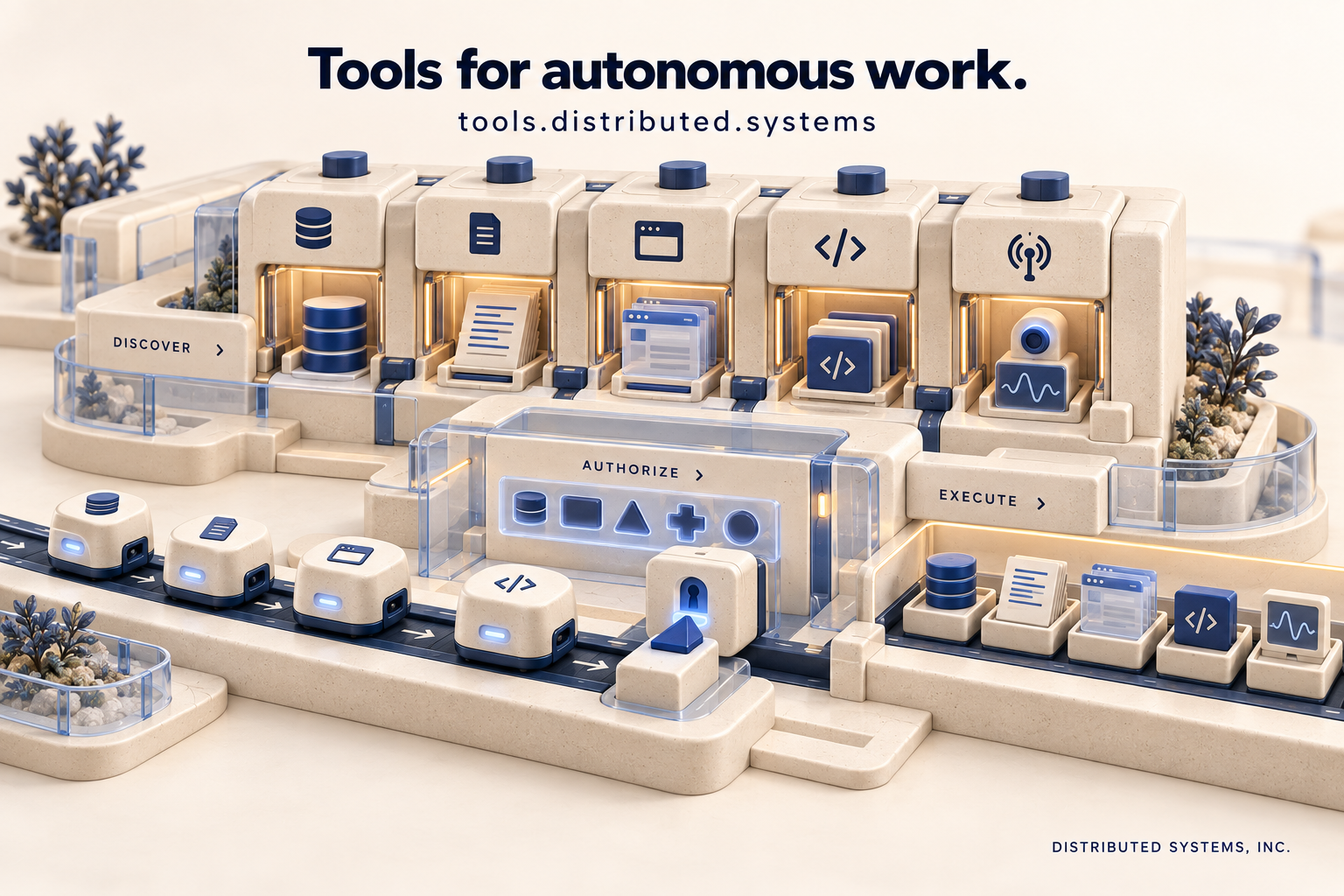
- 01
Discover
Find candidate tools for the task and inspect their schemas.
- 02
Resolve access
Check the caller, credentials, and permissions required by the selected operation.
- 03
Execute
Submit the operation or composition with explicit inputs.
- 04
Inspect the result
Read the response and execution state before deciding what happens next.
Example workflow
From a research question to a usable artifact.
A research agent can discover a search capability, retrieve source material, transform the results, and pass a structured artifact to the next step. Each operation has a defined input and output, so another client can inspect the work.
- 01Find sources
- 02Retrieve evidence
- 03Transform results
- 04Return an artifact
04 / The connected system
The API and the harness have different jobs.
The Tool Management API exposes executable services. DSCO is the local agent harness that directs work from a terminal and can call those services. A team can use the API from its own application, or use DSCO as the operator.
Tool availability and access belong to the selected service and account. A catalog entry describes a capability; the execution result tells you what actually happened. Keeping those two facts distinct is part of building dependable agent workflows.