01 / Overview
The decision before the answer.
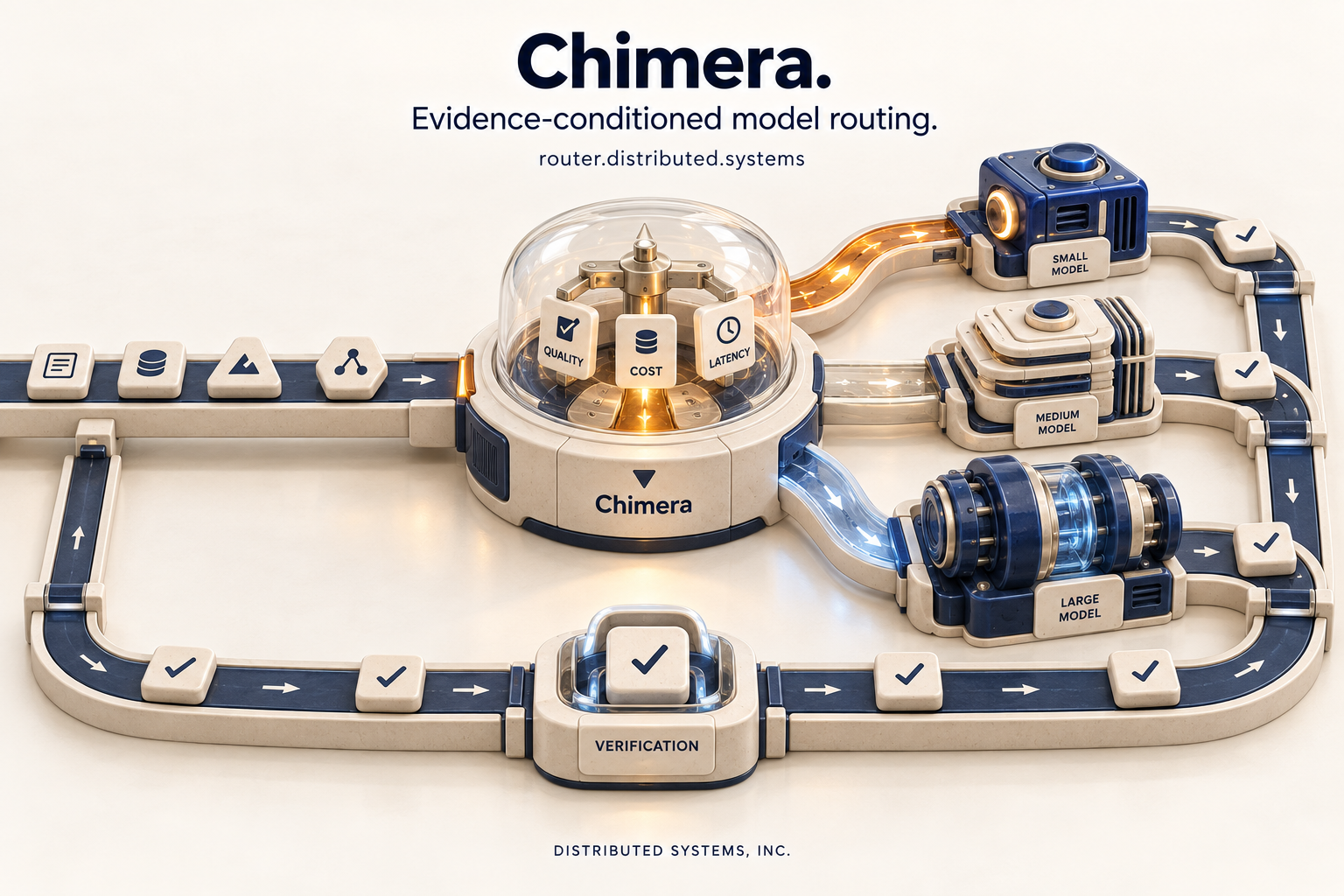
Some requests need a single model. Others benefit from escalation or several independent attempts. Chimera studies this decision: how should a request execute, given the task, available models, quality requirements, cost, and latency?
Chimera is a trained language-model dispatch controller within our routing service. Its output is a bounded execution plan. The chosen models perform the underlying task, while the router handles the provider connections and the accounting around the request.
02 / Capabilities
What it brings to the work.
Select an execution pattern
Choose a direct call, a cascade that can escalate, parallel attempts, or refusal when constraints cannot be met. The plan makes the decision inspectable before execution.
Respect the constraints
Consider the request’s cost and latency preferences alongside available model capabilities. Evaluate dispatch behavior against held-out tasks and explicit constraints.
Preserve provider identity
The surrounding router tracks provider lanes, account authority, usage, and metering. Different credentials retain their own access and transport requirements.
03 / How it works
Choose how intelligence gets used.
- 01
Describe the task
Bring the request, required capabilities, and operating preferences.
- 02
Check eligibility
Resolve which model and provider paths are available to the caller.
- 03
Choose a plan
Select a bounded direct, cascade, parallel, or refused dispatch.
- 04
Observe execution
Retain the selected path and the usage and outcome of the actual request.
Dispatch patterns
Match the amount of work to the task.
A routine extraction may suit a direct call. A difficult synthesis may justify escalation or independent candidates. Chimera makes this choice an explicit object that can be studied and improved.
- 01Direct
- 02Cascade
- 03Parallel
- 04Refuse
04 / The connected system
A routing decision should leave evidence.
A controller can be evaluated on whether it selected valid tools, supplied correct arguments, and respected the request’s constraints. Those are distinct questions from whether the downstream model produced a useful answer.
Our research keeps controller evaluation, serving configuration, and end-to-end results separate. A successful training run establishes evidence for that evaluation; deployment behavior and broader quality or cost improvements require their own measurements.