01 / Overview
A harness around the whole task.
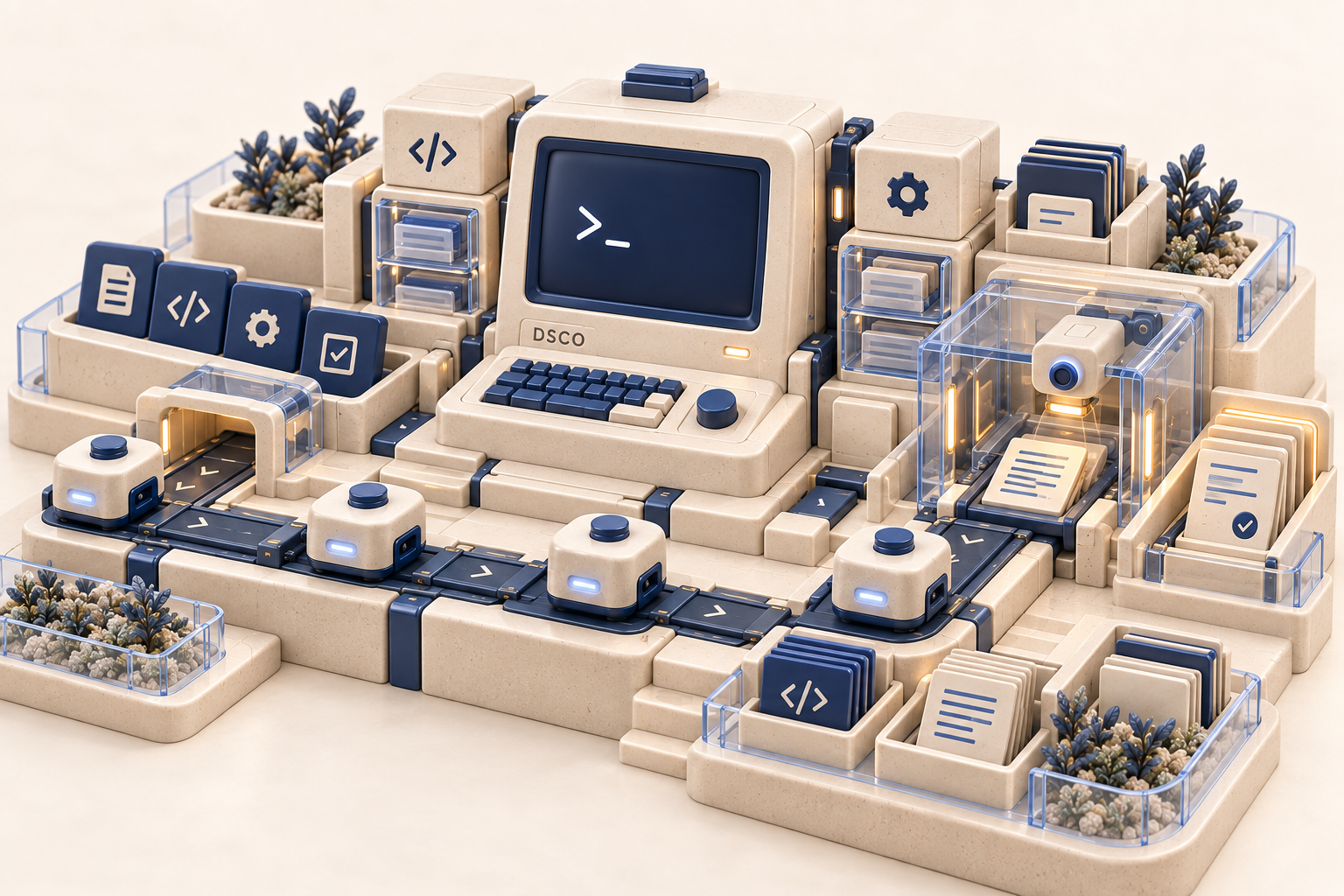
DSCO lives alongside your files, repositories, and local tools. Give it a task and it can inspect the working environment, call tools, edit artifacts, run checks, and carry the results back into the conversation.
The harness is the software around the model: the agent loop, tool registry, provider connections, orchestration, and record of work. Written in C, DSCO makes these parts available as a native runtime that you can inspect and build yourself.
02 / Capabilities
What it brings to the work.
Work where the project lives
Use local files, Git, shell commands, document tools, and code intelligence. The terminal is the operating surface, with tool activity and results visible as the task progresses.
Coordinate several agents
Break work into bounded tasks, choose an orchestration topology, and collect worker results. Hierarchical agents and configurable provider routes support different ways to divide the work.
Connect tools and retain traces
Use built-in capabilities alongside MCP integrations. Local activity records and traces help explain which operations ran and what they returned.
03 / How it works
Autonomous work, at your terminal.
- 01
Give it a task
Start from a concrete objective and the real working directory.
- 02
Inspect the context
Read the relevant files and discover the tools needed for the work.
- 03
Act and check
Execute steps, coordinate workers, and use results to guide the next action.
- 04
Keep the outcome
Leave usable artifacts and a record of the work performed.
Example task
“Read this repository. Fix the issue. Run the checks.”
A practical agent workflow starts with the actual source, makes a focused change, and checks the behavior. DSCO brings the model and execution tools into that same local workspace.
- 01Inspect source
- 02Make a change
- 03Run checks
- 04Review the result
04 / The connected system
One operator for a connected system.
DSCO can call hosted tools through the Tool Management API, use provider routing, and work with source-bound GraphSub artifacts. The runtime remains the place where local actions and permissions are resolved.
Lingo, the shared object and calculation language of Distributed Systems, runs inside DSCO. It adds typed worlds, dependency-aware calculations, and hypothetical scenarios. It lets a program inspect a proposed decision before making an explicit call to a service.
The public repository at arthurcolle/dsco is the starting point for the project. “DSCO” is the product name; “dsco” is the command you run.
Read the source and getting-started guide (opens in a new tab)